The kitchen in my mother’s house still had the same yellowish ceiling light it had when I was seventeen.
It made everything look flatter than it was.
The beige cabinets.
The old counter with a chipped corner by the sink.
The refrigerator covered in grocery coupons, church reminders, and a small American flag magnet Linda had bought after Memorial Day and never taken down.
I stood beside the table with my hands relaxed at my sides, listening to the rain tap the glass over the sink.
For fifteen years, that sound had belonged to somewhere else in my memory.
Back then, it meant I was waiting for my mother to come home from a double shift.
It meant wet sneakers by the back door and microwave dinners on paper plates.
It meant telling myself I would leave one day and never come back unless I had a reason stronger than guilt.
That afternoon, I had a reason.
Linda had called three times that week before I answered.
She had used the voice she saved for neighbors, church friends, and customer service people who could help her get fees removed.
Warm.
Fragile.
A little wounded.
“Maya, it’s been too long,” she said.
I almost laughed.
Too long was what people said when they wanted to skip over why the silence started.
Too long was easier than saying, “I let my new husband turn this house into a place you could not breathe.”
But I did not laugh.
I had spent enough years in rooms where one careless sound could change the temperature of an entire operation.
I simply said, “What do you need?”
There was a pause.
Then came the sigh.
“Just dinner,” she said. “One normal dinner. Silas wants to make peace.”
Silas Vane never wanted peace.
He wanted witnesses.
He wanted his version of events established early, loudly, and in uniform.
He had been a patrol officer when my mother married him, and the badge had become more than a job to him.
It was a stage prop.
He wore it to family cookouts.
He wore it in grocery stores even when he was off duty.
He wore it in stories about “respect” and “order” and “how people should know who they’re talking to.”
When I was nineteen and packing the last of my clothes into a duffel bag, he stood in the hallway and told me I would come crawling back.
“Girls like you always do,” he said.
I remembered the exact way my mother looked at the floor.
Not at me.
Not at him.
At the floor, as if the carpet had asked her a question she could not answer.
Years later, people liked to ask what made me good at my job.
They expected me to mention training.
They expected strategy, discipline, field experience, the kind of hard words that sound impressive in briefings.
The truth was simpler.
I learned young how to read a room before anyone admitted it had turned dangerous.
By the time I walked back into my mother’s kitchen, I had read rooms in places Silas could not pronounce without stumbling.
I had led operations through static, smoke, political pressure, and the kind of silence that comes after everyone understands the cost of being wrong.
And still, stepping through that back door made my chest tighten.
Not with fear.
With recognition.
The house smelled like burned coffee and pot roast.
Linda hugged me with one arm.
Her other hand stayed on her phone.
“You look tired,” she said.
“You look the same,” I answered.
She smiled like she could not decide if that was an insult.
I had chosen my clothes carefully.
No dress uniform.
No ribbons.
No polished shoes.
Just a faded gray hoodie, dark jeans, and old sneakers that had carried me through airports, motor pools, and hospital corridors where young soldiers waited for news they did not want.
The hoodie was deliberate.
So was the button sewn near the collar.
So was the phone I placed face down on the kitchen table after confirming the secure line had not disconnected.
The call had begun as routine.
A briefing.
A narrow, classified conversation about readiness, movement, and timing.
Then Linda had opened the back door and said, “Put that away while you’re in my house.”
I told the people on the line I would reconnect after dinner.
One of them asked whether I wanted the line closed.
I looked at Silas’s patrol cruiser in the driveway and said, “Leave it live.”
No one questioned me.
People who reach four stars do not get there because other people have to ask whether they mean what they say.
Dinner began with the scrape of forks and the kind of small talk that tries too hard.
Linda talked about the price of eggs.
Silas talked about neighbors parking too close to his curb.
He said “my curb” as if the asphalt had been issued to him with his badge.
I let him talk.
I had spent years learning that men who love control often reveal the map if you let them walk through it.
He looked me over three times before he said it.
“So what do they have you doing now?”
Linda answered before I could.
“Office work,” she said brightly. “Maya does paperwork for the military.”
Silas smiled.
There it was.
The old family arrangement.
Linda minimized.
Silas performed.
I absorbed.
Except I was not a girl at that table anymore.
“Some paperwork,” I said.
His fork paused.
“What’s that supposed to mean?”
“It means paperwork can move things.”
“Things,” he repeated, leaning back.
“People. Equipment. Response networks.”
Linda waved her hand as if I had embarrassed her.
“She always talks like that now,” she said. “Very serious. Very secretive.”
Silas chuckled and reached for his coffee.
“You know what I think?” he said.
I did not answer.
He took that as permission.
“I think you got yourself some fancy government desk and forgot where you came from.”
The rain grew harder against the window.
The kitchen light buzzed faintly.
I could hear the secure line in my phone, not as words, but as presence.
A room somewhere far away had gone quiet.
“I remember exactly where I came from,” I said.
That was the first mistake, if you believed in avoiding conflict at all costs.
I did not believe in that anymore.
Avoiding conflict had been my mother’s religion.
She worshiped at the altar of not making it worse.
She forgave things that were not accidents.
She explained tones, looks, threats, broken plates, locked doors, and the long nights when I sat awake with my shoes on because I did not know when I might need to leave.
Silas set his mug down.
“You got mouthy.”
“I got older.”
Linda’s face tightened.
“Maya,” she warned.
Not Silas.
Me.
Always me.
Because asking the dangerous person to stop was risky.
Asking the wounded person to stay quiet was habit.
Silas pushed his chair back.
The legs screamed against the tile.
He stood slowly, smoothing the front of his uniform shirt with two fingers.
“Say that again.”
I looked at him.
He wanted flinching.
He wanted apology.
He wanted the old shape of the room to re-form around him.
“I said I got older,” I told him.
For one second, nothing happened.
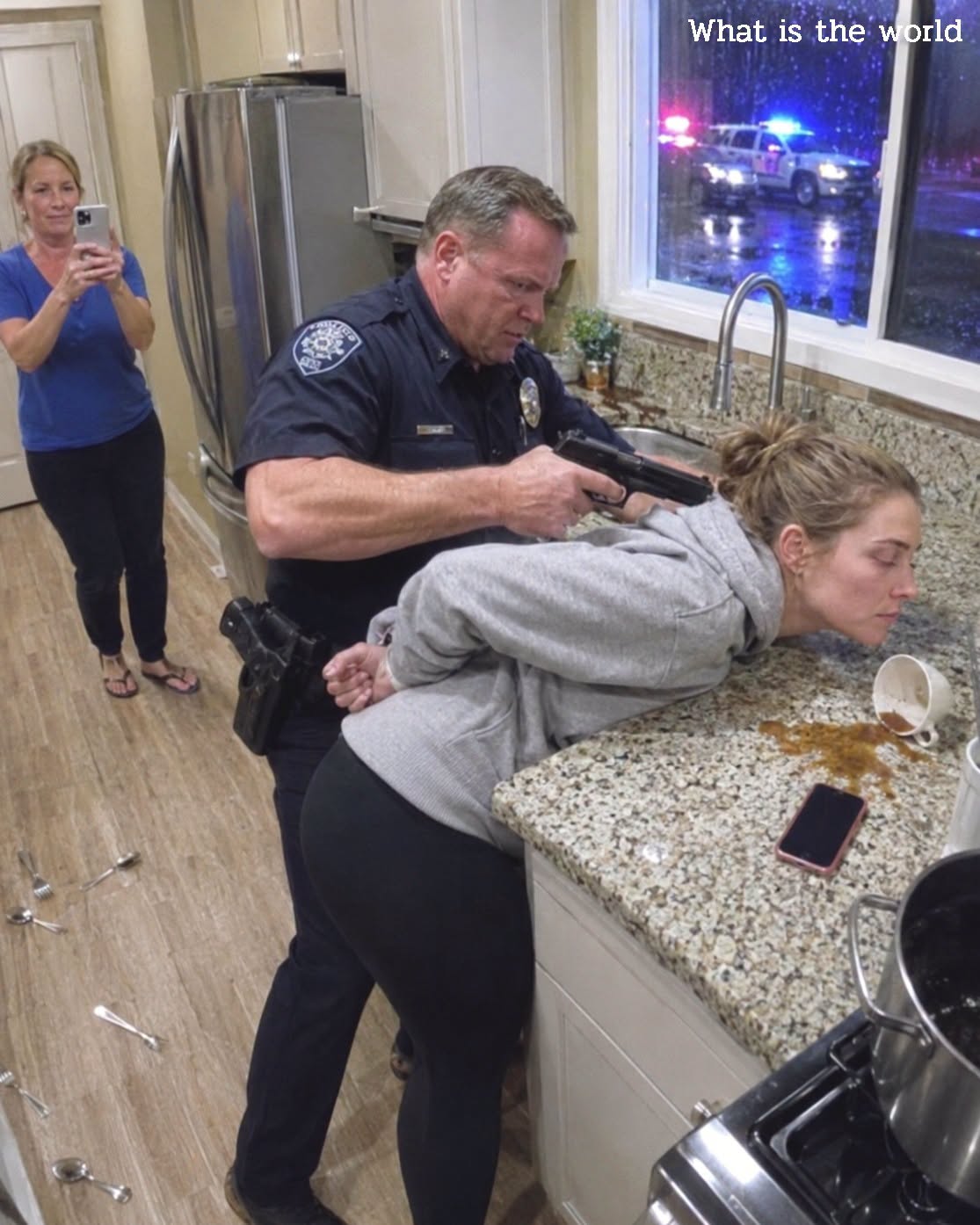
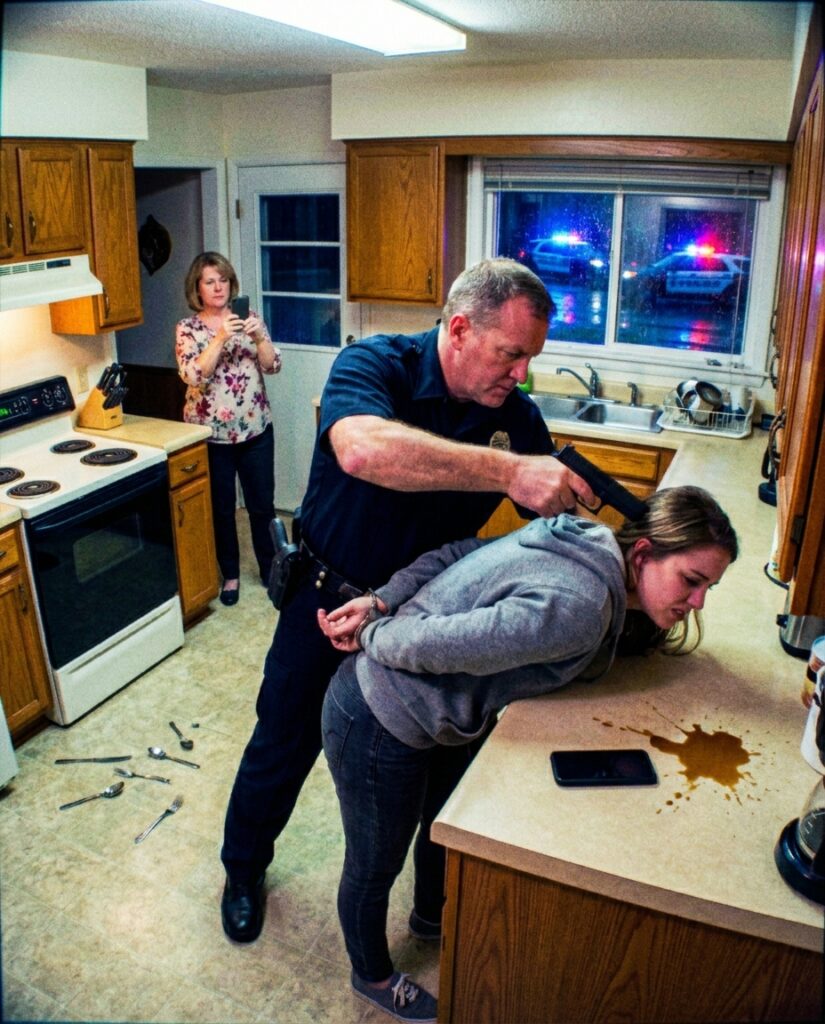
Then his hand came down on my shoulder hard enough to turn me sideways.
Linda gasped, but not in surprise.
In warning.
As if I had made him do it.
My hip struck the counter and pain shot bright across my side.
The silverware drawer rattled open.
Spoons spilled across the floor in a scattered metallic clatter that sounded absurdly domestic.
That was the detail that stayed with me.
Not the shove.
Not the cuffs.
The spoons.
Tiny ordinary things suddenly everywhere.
Silas moved with the confidence of a man who had done rough things before and been believed afterward.
He twisted my arms behind me.
The cuffs clicked once.
Then again.
Cold metal tightened around my wrists.
The bite was familiar enough to be almost insulting.
I had been restrained in training exercises more controlled than Silas’s temper.
I let my breath settle low.
He expected struggle.
I gave him stillness.
Stillness made men like him nervous, but it also made them talk.
Linda stepped backward.
I heard her phone case knock against the refrigerator.
Then the soft beep of recording.
I turned my head enough to see her lift the phone.
She was not calling 911.
She was filming.
For a second, I saw the woman who used to braid my hair before school.
The woman who saved coupons in envelopes.
The woman who once stood in the doorway of my room and whispered, “Just keep quiet until morning.”
I had spent years trying not to hate her for that.
At some point, pity and anger become the same weight in different hands.
Silas shoved me forward until my cheek was inches from the counter.
The coffee mug tipped.
Dark liquid spread in a thin, hot sheet toward my sleeve.
Then I felt the cold circle of his Glock near my temple.
The room narrowed.
Linda’s breathing.
Rain on glass.
Coffee dripping from the counter lip.
The hum of the refrigerator.
My own pulse steady at sixty.
“You think your city uniform makes you special?” Silas said against my ear.
I was not wearing a uniform.
That was part of the humiliation he wanted.
He needed the imaginary version of me to attack.
A girl playing at authority.
A secretary with an attitude.
A daughter who forgot her place.
“To me,” he said, “you’re just a girl who needs to learn her place.”
Linda gave a weak laugh.
Then a stronger one when he looked at her.
“Maya, stop being dramatic,” she said, phone still raised. “You’re just a secretary.”
The words did not hurt the way she thought they would.
There had been a time when I needed my mother to see me clearly.
That time had passed so quietly I almost missed its funeral.
On the table, my phone lay beneath a grocery receipt.
The receipt covered most of the screen, but not the thin red line showing the call was active.
The button camera near my collar had a tiny dull finish designed to look cheap.
It was not cheap.
It was designed for rooms where pretending to be ordinary was safer than announcing importance.
In a secure room far from that kitchen, people were watching.
Not all of them knew the whole history.
They did not know about the hallway when I was nineteen.
They did not know about Linda looking at the floor.
They did not know that Silas once told me no one would believe a girl like me over a man in uniform.
But they understood the present.
A local officer had restrained and threatened a United States general on a live classified line.
The fact was clean.
The response would be cleaner.
Silas pressed harder.
“I could pull the trigger right now and tell the department you reached for my weapon,” he said. “Linda will testify. The neighbors will believe me.”
My mother’s face changed.
Just for a breath.
I saw fear there.
Not fear for me.
Fear of being asked to choose.
Then she lifted the phone higher.
“You are nothing, Maya,” Silas said.
I looked at the microwave clock.
2:02 p.m.
The numbers glowed green above the stove.
Time matters.
In my work, people like to talk about courage as if it is a feeling.
It is not.
Courage is the decision to obey the next correct second.
One second, you breathe.
The next, you listen.
The next, you speak only if speech helps.
I breathed once through my nose.
“Silas,” I said, calm enough that Linda’s phone dipped slightly.
He hated calm.
Calm denied him the performance.
“You have ten seconds to lower that weapon before your world collapses.”
He froze.
Then he laughed.
It was jagged and mean and too loud for the room.
“Listen to her,” he said to Linda. “World collapses.”
Linda smiled because he wanted her to.
Her smile trembled at the edges.
“Let’s see how a ‘General’ handles a real bullet,” Silas said.
He put a mocking weight on the title.
As if the word itself was a costume.
As if he could strip it off me with ridicule.
In Washington, the room on the other end of the line had already moved from silence into action.
A three-star general who had known me for eleven years slammed his fist onto the table hard enough to rattle headsets.
“Track that GPS,” he barked.
A communications officer confirmed the location.
A legal adviser demanded the feed be preserved.
Someone else said the local chain of command was compromised until verified.
Every phrase was clipped.
Every verb mattered.
Locate.
Confirm.
Record.
Dispatch.
In the kitchen, Silas heard only himself.
That was always his weakness.
Men like him mistake volume for control.
They do not understand that the quietest person in the room may already have changed the ending.
The secure line crackled softly under the grocery receipt.
Linda heard it first.
Her eyes flicked to the table.
Silas was still leaning over me, still smiling into her phone like he was starring in his own evidence.
Then my phone lit up.
Not with a contact photo.
Not with a normal call screen.
With a secure alert code in blocky white characters.
Linda’s smile disappeared.
The red recording dot on her phone shook.
“What is that?” she whispered.
Silas followed her stare.
For the first time since he put the cuffs on me, his grip changed.
Not looser.
Not yet.
But uncertain.
The voice came through the speaker low and controlled.
“General Thorne, hold position.”
No one moved.
Even the rain seemed to go quiet for half a second.
Linda’s lips parted.
“General?” she said.
The word did what years of explanations never could.
It entered the room and rearranged every object inside it.