
ADVERTISEMENT
I counted every one of them.
When Sophie was brought back, she complained that the machine had been loud but said the headache was worse. A nurse dimmed the lights and gave her medicine.
Then Dr. Ortiz asked the adults to follow her into a consultation room.
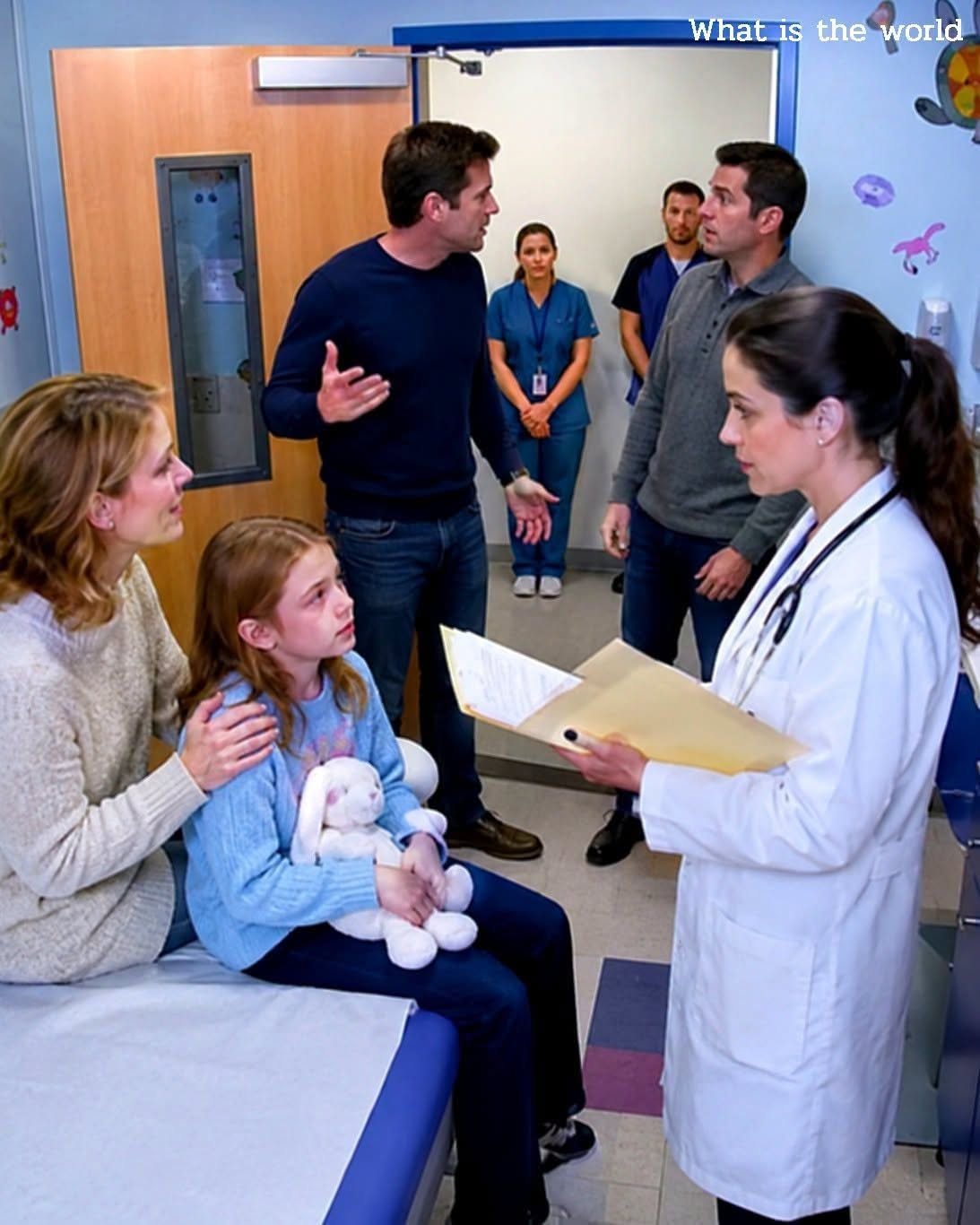
Sophie refused to let me leave, so the meeting happened at her bedside. Daniel sat on her right. I sat on her left. Eric remained near the window.
A new doctor introduced herself as Dr. Priya Shah, a pediatric endocrinologist.
She placed an MRI image on the monitor.
Most of it looked like meaningless shades of black and gray. Near the center was a pale, irregular shape.
“We found a mass near the base of Sophie’s brain,” Dr. Shah said.
I waited for someone to correct her.
No one did.
“What kind of mass?” Daniel asked.
“We believe it may be a germ cell tumor located near the area that controls hormone production, thirst, and several aspects of development.”
Eric gripped the windowsill.
“Are you saying she has cancer?”
“We need additional imaging and tumor-marker studies before we can determine the exact type.”
I looked at Sophie. She was watching all of us, trying to decide how frightened she should be.
“Is that what caused the headaches?” I asked.
“Most likely. It is also pressing near the pathways involved in peripheral vision.”
Sophie touched the side of her head.
“But what does that have to do with the pregnancy test?”
Dr. Shah pulled her chair closer.
“A pregnancy test does not actually look for a baby. It looks for a hormone called hCG.”
“The hormone in my blood?”
“Yes. Pregnancy is the most common reason for that hormone to appear. But some germ cell tumors can produce it too.”
No one spoke.
The truth was too large to enter the room all at once.
“There was never a baby?” Sophie asked.
“No,” Dr. Shah said. “You are not pregnant.”
ADVERTISEMENT
