
ADVERTISEMENT
Claire had spent twelve hours at St. Mercy Medical Center, most of them moving between patients beneath fluorescent lights, when she finally walked through the parking garage toward her car.
Her feet hurt inside her work shoes, her scrubs smelled like antiseptic and old coffee, and all she wanted was a shower followed by several hours of uninterrupted sleep.
Her phone had other plans.
It had been vibrating in her pocket for nearly twenty minutes, but she assumed the messages were routine family chatter that could wait until she reached her apartment.
When she parked outside her building in Portland, Oregon, she looked at the screen and saw that her father had tagged her three times in the family group chat.
The first message was not a question.
“We’re using your lake house this weekend—20 guests.”
Her mother followed with another order: “Fill the fridge and behave.”
Kyle, Claire’s younger brother, added a row of laughing reactions as if their parents had made a clever joke instead of announcing plans to take over a house Claire owned.
Claire remained in the driver’s seat with the engine off, watching themessages sit on the glowing screen while the last of the hospital’s stale coffee taste lingered in her mouth.
Her lake house near Devils Lake was not a shared vacation property, an inheritance, or a place her parents had helped her purchase.
It belonged to Claire because she had bought it with money earned through six years of double shifts, overtime, and the kind of careful budgeting that had once required her to count every grocery item before reaching the register.
During those years, she had lived with roommates who helped themselves to her food, worked holidays when other people went home, and postponed nearly every comfort that could wait.
The house was the one comfort she had eventually allowed herself.
It was quiet enough for her to sleep after difficult shifts, far enough from Portland to feel separate from work, and private enough that she could sit on the porch without anyone evaluating her choices.
Her parents had never understood privacy as something Claire was entitled to possess.
They treated her time as flexible because she did not have children, her nursing schedule as something that could be rearranged for family convenience, and her property as available whenever they decided their plans mattered more than hers.
The previous summer, her father had “borrowed” the lake house without asking properly and left beer cans around the hot tub.
Claire had cleaned the mess herself and then listened to him describe the incident as a misunderstanding.
She had changed the door code afterward, but she had eventually given her parents the new one because her mother insisted that withholding it was disrespectful.
Now they were planning to arrive with twenty guests and expected Claire to stock the refrigerator before they came.
She typed a single word into the group chat.
“No.”
Her mother answered almost immediately, asking whether Claire honestly thought she could stop them.
The laughing tone of the message bothered Claire more than an ordinary argument would have because it revealed that her mother did not consider refusal a real option.
Her father sent a voice message a few seconds later.
Claire watched the audio icon appear but did not press it because she already knew what she would hear: a command delivered in a wounded voice, followed by a reminder that families were supposed to share.
She could have explained the mortgage, the insurance, the tax payments, the maintenance costs, or the hours of work that had made the purchase possible.
She had explained those things before.
The facts had never changed her parents’ behavior because the conflict was not about whether they understood who owned the house.
It was about whether they believed Claire would enforce the boundary.
She carried her bag upstairs, showered, changed into clean clothes, and called Margaret Harper, the neighbor who lived across the gravel road from the lake house.
Margaret had watched the property during storms, collected an occasional package, and helped Claire identify the mess after her father’s visit the previous summer.
“Margaret, if any cars arrive this weekend, they do not have permission to enter,” Claire said.
Margaret was quiet for a moment before asking, “Your parents again?”
“Yes.”
“All right,” Margaret replied. “I’ll keep an eye out.”
Claire opened her laptop and logged into the house’s smart security system.
She changed every active door code, disabled the older garage keypad, removed access to the guest Wi-Fi network, and activated the exterior cameras that covered the porch, garage, and driveway.
The adjustments took only minutes, but they represented a decision Claire had avoided making for years.
She was no longer trying to persuade her parents to respect a boundary voluntarily.
She was making the boundary real.
Her next call went to the local locksmith who had helped her after the previous summer’s unauthorized visit.
He remembered the situation and agreed to replace the locks that morning.
By noon, the physical keys her parents might still possess were useless.
By three, Claire had used the sheriff’s office non-emergency contact to provide a written statement explaining that nobody had permission to enter the property that weekend.
She did not accuse her parents of something they had not yet done, and she did not ask anyone to punish them in advance.
She simply documented her refusal before they arrived and claimed later that everything had been a misunderstanding.
Once the message was sent, Claire placed her phone on the nightstand and slept.
She woke Friday morning to forty missed calls.
Her father’s name appeared over and over, mixed with messages from her mother and notifications from the family group chat.
Claire sat up, opened the security application, and watched the live camera feed before answering the forty-first call.
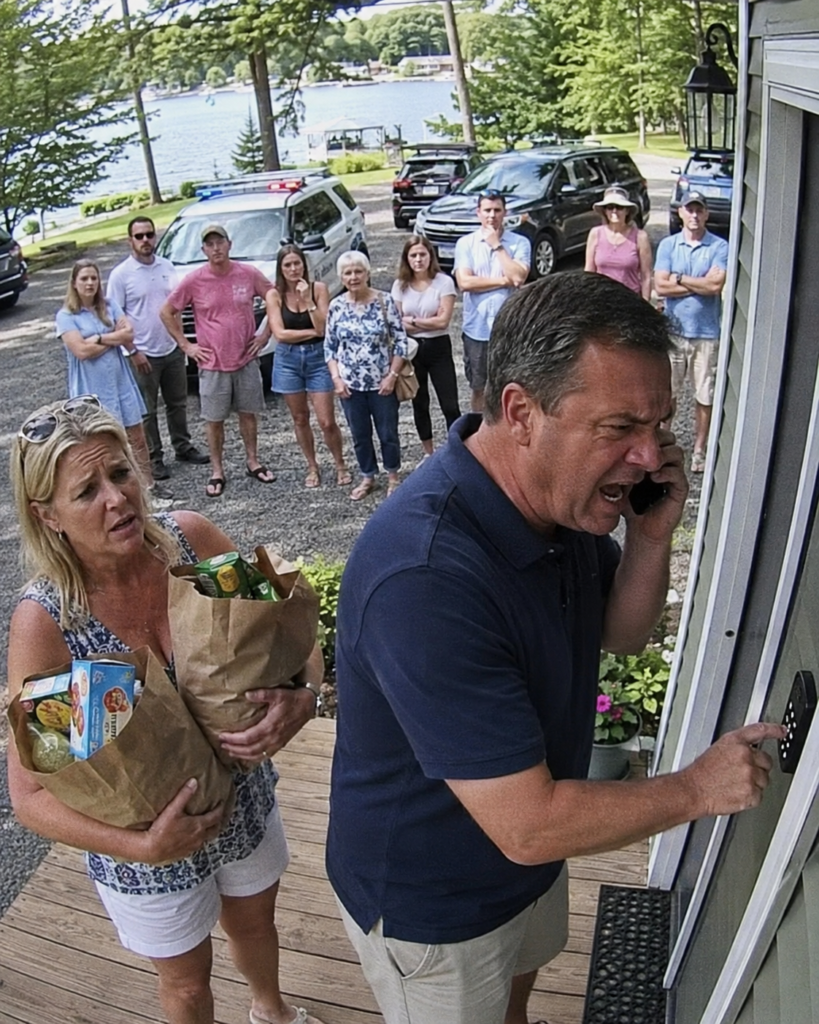
Twenty adults crowded around her front porch and along the gravel driveway.
Several SUVs were parked at awkward angles, paper grocery bags covered the porch boards, and her parents stood directly in front of the locked door.
“What did you do to the house?” her father screamed when she answered.
His voice carried over the wind, and Claire could hear her mother in the background demanding that he tell Claire to stop acting crazy.
Claire glanced at the time and said, “Good morning.”
“Don’t you good morning me,” he shouted. “The front door code doesn’t work. The garage is locked. There are cameras everywhere. Your mother is standing outside with groceries melting, and everyone is staring at us.”
Claire enlarged the porch image on her phone.
Her mother held two overloaded paper bags against her chest while more groceries sat near her feet, and the guests behind them shifted with the discomfort of people beginning to suspect that their hosts had not told them the whole story.
“Then everyone should leave,” Claire said.
“This is a family weekend.”
“No,” Claire replied. “It is an attempted entry onto property you were told you could not use.”
The people behind her parents could not hear Claire clearly, but they could hear her father, whose volume made the disagreement impossible to hide.
He moved away from the group and lowered his voice into the controlled tone he used when anger alone had failed.
“Open the door, Claire.”
She watched through the camera as he looked up toward the lens above the porch.
The request sounded calmer, but nothing about it had changed because he was still telling her what to do with her own house while twenty people waited behind him.
Claire did not answer.
Her father looked over his shoulder, and several guests turned with him as a sheriff’s cruiser entered the gravel driveway.
The cruiser rolled to a stop behind the last SUV, blocking no one but making it impossible for my parents to pretend the situation was still private.
A deputy stepped out and looked from the crowded porch to the grocery bags, the disabled keypad, and the camera above the door.
Dad kept me on speaker. “Officer, our daughter locked us out of the family place.”
“It is not the family place,” I said through the phone. “I own it, and I told them in writing that they did not have permission to enter.”
Mrs. Harper walked over from across the gravel road and stopped beside her mailbox. She told the deputy she had watched the cars arrive and had heard my father tell the guests that I would eventually give in.
Mom turned toward the crowd. “Claire is exhausted. She works too much and gets dramatic when she’s tired.”
One of the guests looked at Dad. “You said she invited us.”
Dad did not answer that question. He pointed at the house instead and said, “Family does not need an invitation.”
The deputy asked whether either of my parents had a current code, a key, or a message from me granting access.
They had none.
Then he picked up Dad’s phone and spoke directly to me. “Claire, they have not entered the house. Do you want them instructed to leave the property?”
My mother heard him and shouted my name as if the right tone could turn me back into a child.
I looked at the home I had paid for, the locked door I had finally protected, and the twenty people waiting to see whether my no meant anything.
“Yes,” I said. “Tell them to leave.”
The deputy returned the phone to Claire’s father and explained that the owner had clearly withdrawn permission for everyone present to remain on the property.
He did not shout, threaten anyone, or turn the disagreement into a larger spectacle.
He simply told the group to collect their belongings, load the groceries, and leave the driveway.
Claire’s father argued that the house had always been available to the family, but the deputy asked again whether he possessed current permission from the owner.
Her father answered by describing everything he had done for Claire while she was growing up.
The deputy repeated the question.
Her father still could not produce a key, a working code, or a message granting access.
Claire’s mother moved closer to the phone and changed tactics.
“You are humiliating us in front of everyone,” she said.
Claire looked at the camera feed and saw the guests beginning to lift grocery bags from the porch.
“I told you not to come,” Claire replied. “You brought everyone anyway.”
Her mother said the food would spoil, the weekend had been planned for weeks, and several people had driven a long way.
Each complaint described a consequence of her parents’ decision, but her mother delivered them as if Claire had created the problem by refusing to surrender the house.
One guest carried two bags toward an SUV while another picked up a case of bottled water.
The cheerful group that had arrived expecting a free lake weekend now moved quietly, avoiding eye contact with Claire’s parents and one another.
A woman near the porch asked Claire’s father why he had told everyone the house was available if Claire had already said no.
He blamed the disagreement on Claire’s work stress and repeated that she had always been difficult when tired.
The explanation sounded weaker each time he used it because the locked door, changed codes, written notice, and active security cameras were not signs of confusion.
They were deliberate actions taken by an owner who expected her refusal to be ignored.
Margaret remained near her mailbox and watched without adding another accusation.
Her presence mattered because she had seen the cars arrive and had heard Claire’s father assure the group that the door would eventually open.
The guests did not need a dramatic confession or a stack of hidden documents to understand what had happened.
They had been invited to a house by people who did not own it, after the actual owner had refused permission.
Claire’s father raised the phone again and told her that the family would remember what she had done.
Claire almost responded by listing everything they had done first, including the order to fill the refrigerator, the laughter after her refusal, and the arrival of twenty people at a locked property.
Instead, she said, “I hope everyone remembers that I said no before they drove here.”
It was not a clever comeback, and it did not end the argument instantly.
It placed the timeline where it belonged.
The deputy waited while the last bags were removed from the porch and the guests returned to their vehicles.
Claire’s mother stood beside the passenger door of an SUV, still holding one sagging grocery bag, and stared at the lake house as if it had betrayed her by remaining closed.
Claire’s father was the last person to leave the porch.
ADVERTISEMENT
